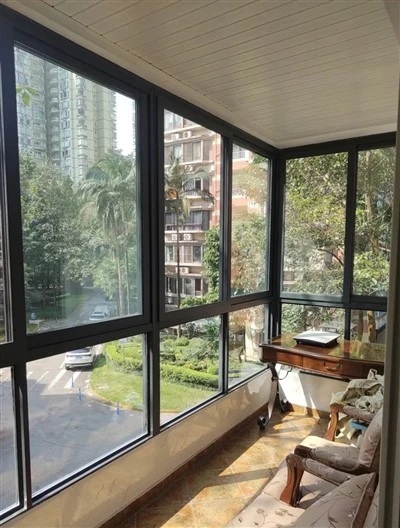
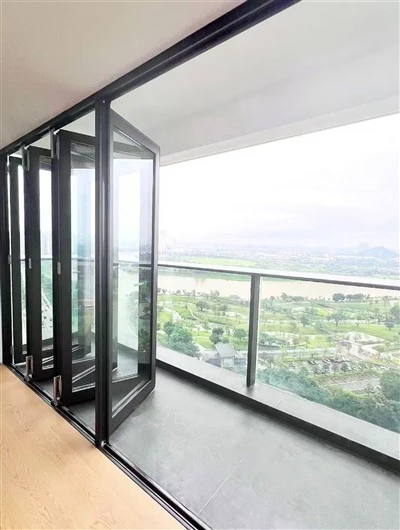
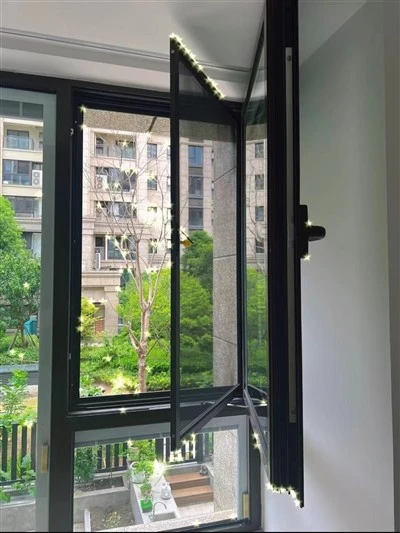
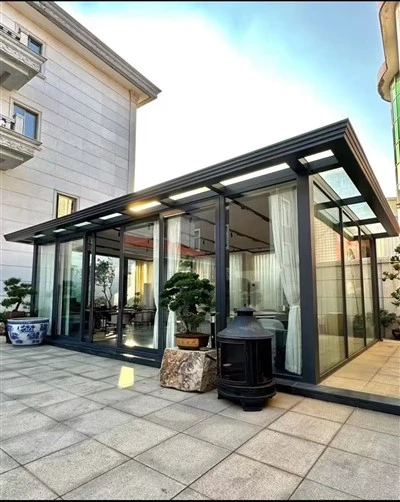
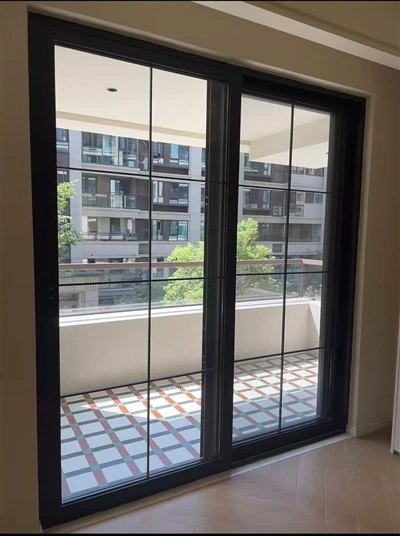
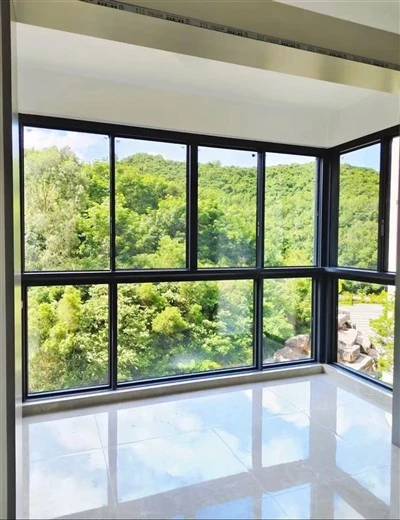
Aluminum door profiles and glass styles differ between northern and southern China. Northern styles are characterized by thicker aluminum and a more robust, understated look, with the grid pattern being the most representative, and the Tang grid being the most distinctive. Southern styles are characterized by diverse aluminum shapes and lively designs, with patterned glass being the most representative, including patterns such as lattice, ice carving, shallow carving, and shell carving.
Folding Doors
Folding doors mainly consist of a door frame, door panels, transmission components, swivel arm components, transmission rod, and directional device. This type of door can be installed both indoors and outdoors. Each door has four panels: two side panels and two center panels. The side door leaf is connected to the middle door leaf by a hinge on one side of its frame. The other side of the side door leaf has upper and lower pivots at its top and bottom ends, respectively. These pivots connect to the upper and lower pivot seats on both sides of the door frame. The side door leaf rotates around this pivot, simultaneously rotating the middle door leaf 90°, thus opening and closing the door. In electric operation, a rotating arm and transmission components are mounted on the upper pivot end, while the transmission components and the door opener are mounted in the middle of the upper part of the door frame. The middle door leaf has a directional device. When the door opener operates, it drives two gears in each part of the transmission component to rotate. The two racks meshing with these gears move linearly, and the other end of the racks connects to the rotating arm, which moves in a circular motion. This causes the side door frame to rotate around the pivot, electrically opening the door leaf. Both middle door leaves have safety protection devices installed in their central seams. If an obstacle is encountered when closing, the door returns to the fully open state, ensuring safety and reliability.
Doorway widths range from 3000-4800mm, and heights range from 3000-4800mm, with 26 different specifications available, all in both electric and manual versions.
Partition Door: Definition: A partition door is a type of door used in interior design to separate two spaces; it serves as a connection.
It guides and transitions between spaces; it is a link between them.
Materials: Partition door materials can include metal, glass, composite panels, fireproof boards, gypsum board, flame-retardant plywood, and more.
The partition door frame can be made entirely of 6063 national standard aluminum extrusion profiles. The material, oxide film thickness, and surface treatment quality all meet GB/T5237-2000 standards; it can also be frameless, directly connected with tempered glass door hinges or fasteners.
The standard track gauge for sliding doors is 39.7mm. There are two styles for the upper track: standard and curved. The lower track also comes in two styles: standard and train track. The concealed frame sliding door uses high-grade aluminum-titanium alloy, solving the problems of easy corrosion, excessive vibration, instability, and safety issues associated with traditional carbon steel concealed frame doors. It also overcomes the risk of lower wheel damage due to center-of-gravity shift in sliding doors. Its unique design makes its sliding wheels compatible with other sliding doors, extending its lifespan.
Regional differences exist in aluminum door profiles and glass styles between northern and southern China. Northern styles are characterized by thicker aluminum and a more robust design, most notably the grid pattern, with the Tang grid being the most distinctive. Southern styles are characterized by diverse aluminum shapes and lively designs, most notably patterned glass, with distinctive styles including lattice, ice carving, shallow carving, and crystal shell.
Opening dimensions